
Russian-to-English
patent translation
Specialist Russian-to-English patent translation and revision by Jaime Holmes, DipTrans MITI — a native English translator, fluent Russian speaker and experienced lead translator for this language pair.
I help patent attorneys, IP teams and language service providers work with Russian-language patent documents: from complete specifications and claims to prior-art passages, abstracts and written opinions. Each translation combines close attention to the Russian with research into the technology it describes.
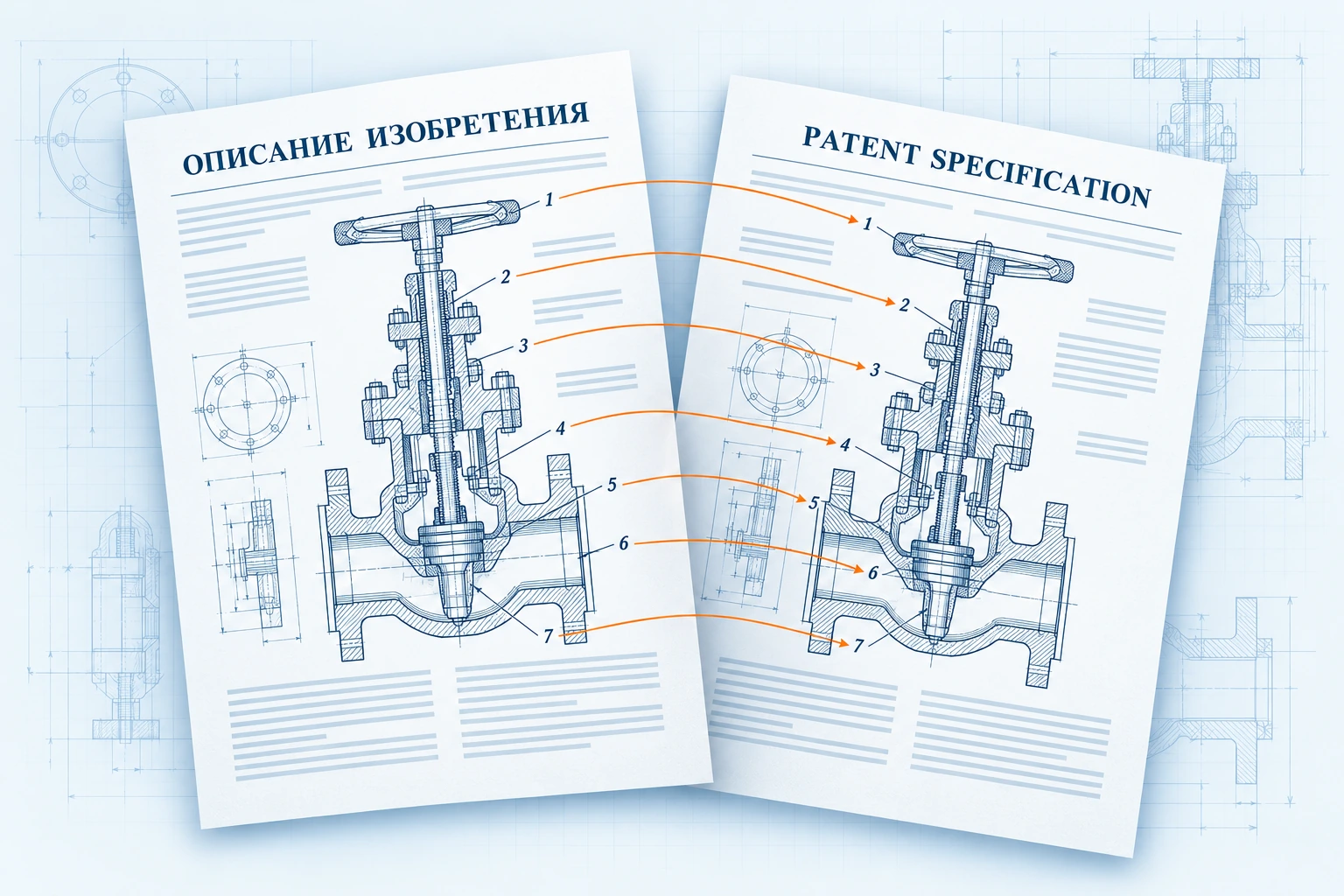
Russian expertise built through life and work
I speak fluent Russian and lived and worked in Russia for many years. I combine that experience of using Russian in daily life and work with more than a decade in patent and technical translation, including extensive PCT/WIPO documentation.
As a lead translator for the Russian–English language pair, I have helped language service providers secure patent-translation tenders and played a substantial role in revision and quality assurance. My experience includes reviewing other translators’ work and resolving questions of terminology and technical interpretation.
This brings a reviser’s perspective to translation from the outset: checking how an interpretation was reached, whether the technical account holds together, and whether the English preserves the distinctions made in the source.
More about Jaime and Translating Patents →I also provide German-to-English patent translation. See the patent translation services page for an overview.
Translation for patent analysis, applications and review
Complete specifications and claims
Russian-to-English translation of patent applications, descriptions, claims and abstracts, with consistent terminology and careful treatment of dependencies, alternatives and technical relationships.
Prior art and selected passages
Translation of the Russian-language material you need to examine: a complete document, particular claims or a passage describing a mechanism or process. The surrounding specification and drawings help establish the meaning of the selected text.
Written opinions, search reports and existing translations
Translation of search and examination material, and bilingual revision of English patent translations against their Russian sources. Tell me how the English will be used so that we can agree the scope and presentation.
My work spans mechanical and electrical engineering, electronics, IT and telecommunications, chemistry and materials, and medical technology. Each enquiry is assessed against its subject matter and requirements.
Russian and Soviet contributions to science and technology
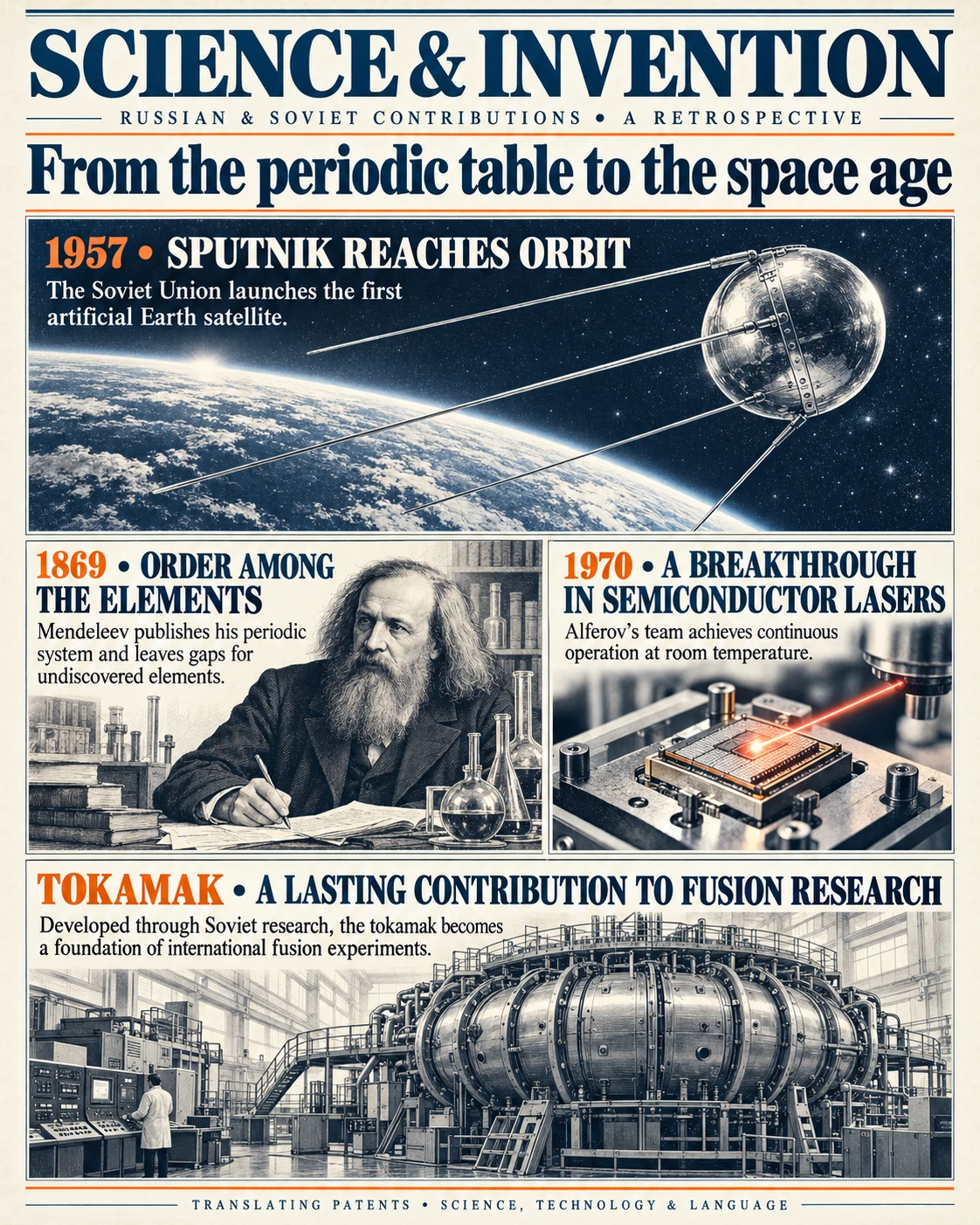
Russian-language technical literature records contributions that have helped shape chemistry, electronics, space exploration and energy research. That history extends from the scientific work of imperial Russia to the research institutes and engineering programmes of the Soviet Union, involving scientists and engineers from across its constituent republics.
Mendeleev and the organisation of chemistry
In 1869, Dmitri Mendeleev published his periodic system of the elements. Its significance went beyond arranging the substances already known: he left gaps for undiscovered elements and predicted their properties. The subsequent discovery of elements including gallium and germanium helped demonstrate the strength of those predictions. His work became a foundation of the modern periodic table — a lasting contribution to how scientists understand and investigate materials.
Sputnik and the beginning of the space age
The Soviet Union’s launch of Sputnik 1 on 4 October 1957 placed the first artificial satellite in orbit around Earth. It marked a decisive step from theoretical and experimental rocketry to operating equipment in space. The satellite’s familiar metal sphere and four antennas remain an immediately recognisable symbol of that achievement.
For readers of technical literature, space technology also brings together many disciplines: propulsion, structural materials, radio communication, power supplies and control systems. Translating documents in these fields requires following how the individual technologies work together, as well as understanding the terminology of each.
From quantum electronics to semiconductor lasers
Nikolay Basov and Aleksandr Prokhorov helped establish the foundations of quantum electronics and the maser–laser principle. They shared the 1964 Nobel Prize in Physics with Charles Townes. Their contribution belongs to an international history of research that made new ways of generating and amplifying electromagnetic radiation possible.
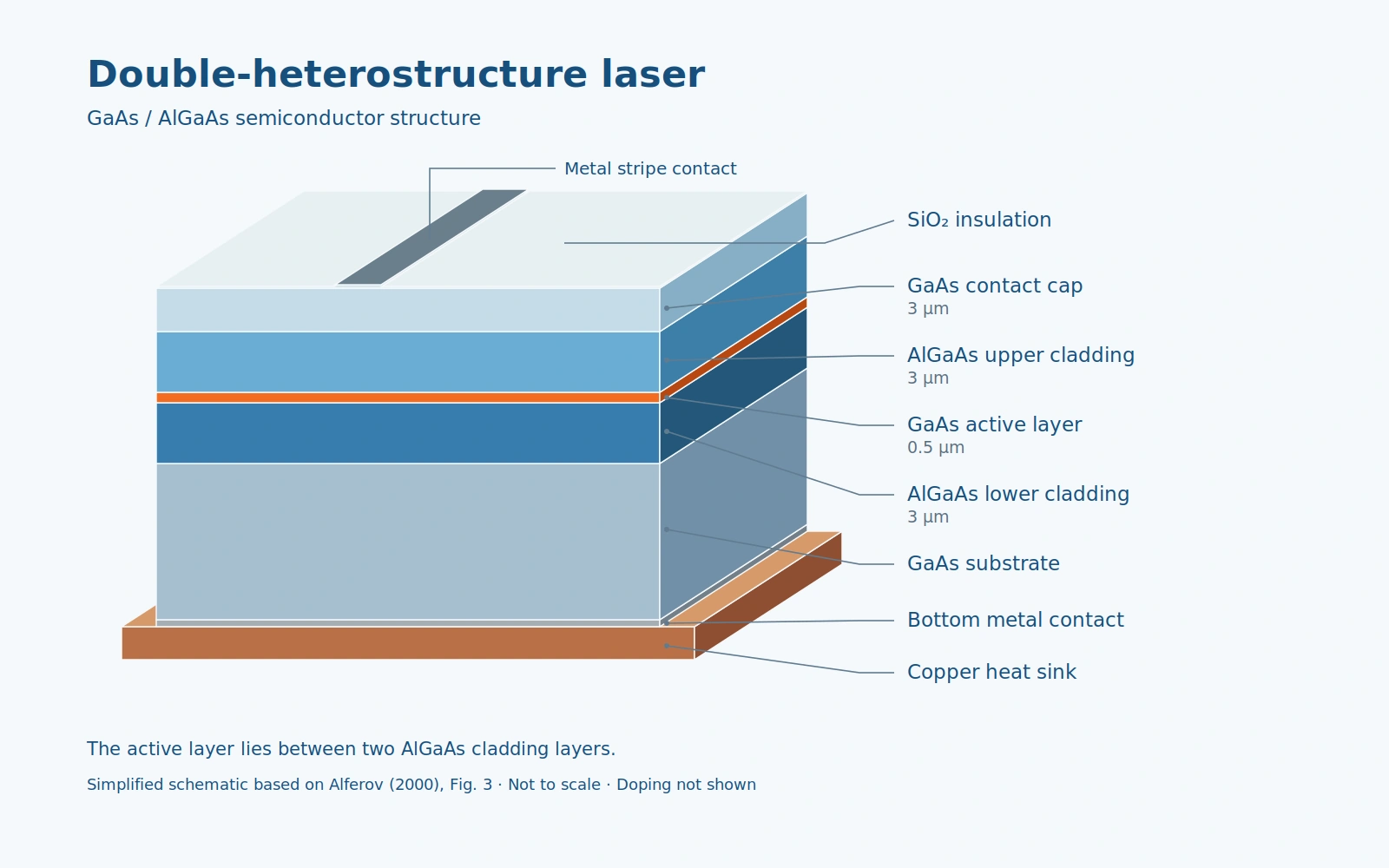
A further major advance came through Zhores Alferov’s work on semiconductor heterostructures — structures combining layers of different semiconductor materials. In 1970, his team demonstrated a double-heterostructure laser operating continuously at room temperature. This was an important step towards practical semiconductor lasers, with applications including optical communications. Alferov and Herbert Kroemer’s contributions to semiconductor heterostructures were recognised with half of the 2000 Nobel Prize in Physics; the other half went to Jack Kilby for his contribution to the integrated circuit.
Tokamaks and fusion research
Soviet research also produced the tokamak, a device that uses magnetic fields to confine hot plasma in a toroidal chamber. Results presented by Soviet researchers in 1968 helped establish the approach internationally. The tokamak subsequently became a central design in magnetic-confinement fusion research, including the international ITER project. Its development illustrates how an engineering approach originating in one research programme can become the basis for decades of work across national boundaries.
A technical record that remains relevant
Alongside these prominent achievements is a much broader record of inventions described in Russian-language patents, inventors’ certificates and scientific publications. Soviet inventors’ certificates are expressly included in the definition of patent documents in PCT Rule 34. Older publications therefore have a place in the documentary material used for international patent searches.
Russian-language patent work can also involve Russian patents and utility models, and Eurasian patent documents. Russian is the official language of the Eurasian Patent Organization, whose patent system serves applicants internationally.
Russian patent translation can consequently involve documents written decades apart, with different terminology, drafting practices and reproduction quality. A modern specification may need comparison with an earlier publication; an unfamiliar component name may require research in contemporary technical literature. Understanding the technology and the period in which it was described helps the translator establish what the source means and choose appropriate English terminology.
The contemporary patent record is substantial too. WIPO’s profile reports 26,698 patent applications at the Russian office in 2024, with 80.5% filed by residents. The profile also lists pharmaceuticals, computer technology, biotechnology, engines, pumps and turbines, and medical technology among the leading technical fields in published patent documents.
For a translation project, this breadth makes the document’s period, technical field and place in a patent family useful starting points for research. Terminology needs to make sense within that particular invention and its technical context.
Understanding what the Russian patent actually says
An English translation can sound technically convincing while describing a different arrangement from the Russian source. It may place a device on a pipe when the Russian merely assigns one device to each pipe, or attach a qualification to the wrong part. Detecting those changes requires comparing the technical meaning of the two texts, not simply checking whether the English reads well.
A feature may be defined by its construction, material, function or ability to move. A qualification may apply to one component, several components or an entire operation. The English needs to preserve those distinctions, including when the Russian uses a compact expression or a long chain of clauses.
I check possible readings against the description, claims, drawings and reference signs, using relevant technical sources and patent-family documents where helpful. A related document can clarify terminology, but the translation must follow the particular Russian text supplied.
How the surrounding passage resolves the translation
In the vehicle-washing example below, the Russian describes two modules, each with two L-shaped pipes. It then places a reference-distance sensor and two devices in the centre of each module, with one device assigned to each pipe. The devices are connected by cables to the control console and issue a command to reverse the movement of the pipes and modules.
That context matters when translating два устройства по одному на каждый Г-образный трубопровод. The phrase specifies two devices, one for each L-shaped pipe. Rendering it as one on each L-shaped pipe turns the relationship between a device and the pipe it serves into a statement about where the device is mounted.
The distinction can be established by reading the sentence as a whole. The passage gives the devices a location within the module and separately assigns one to each pipe. Those are different pieces of information. The English needs to retain both without treating the assignment as a mounting instruction.
This is why a technically plausible sentence still needs to be tested against the source. Both one for each pipe and one on each pipe sound natural. A reader of the English alone might have no reason to question either. Comparing the wording with the Russian reveals that they describe different relationships.
In revision, identifying the problem is only part of the work. The correction should also be explained: here, the change from on to for restores the one-to-one relationship expressed by по одному на каждый. That explanation gives the translator or project team a clear basis for assessing the change.
One device for each pipe: what the Russian specifies
A description of a vehicle-washing system includes два устройства по одному на каждый Г-образный трубопровод: two devices, one for each L-shaped pipe. Translating the final words as one on each L-shaped pipe introduces a location that this phrase does not specify. Here, the Russian specifies one device for each pipe, but does not say that the device is mounted on the pipe.
When a familiar word has a patent meaning
Объект can refer to a physical object or, in the appropriate patent context, to subject matter. Признак may be a feature of an invention, while формула изобретения refers to its claims. The appropriate English term depends on whether the passage describes a physical component, a feature of the invention or the invention’s subject matter.
When the English needs to make a relationship explicit
Высоковольтная и заземлённая шины can be rendered as “a high-voltage busbar and a grounded busbar”. The singular adjectives distinguish two busbars even though Russian uses a shared plural noun. Repeating the noun in English makes the component count and allocation of properties clear.
Russian can also identify a relationship more explicitly than an initial English rendering. In крышка корпуса, на которой установлен датчик, the feminine которой identifies the cover as the sensor’s mounting location. “A housing cover on which a sensor is mounted” preserves that link; “the cover of the housing, on which…” can make it harder to follow.
These are simplified illustrations of translation decisions. The complete source and technical context determine the final wording.
Context is part of the translation process
A term encountered near the beginning of a Russian patent may only become clear several pages later. A later passage can identify the material, distinguish a part from a neighbouring component or explain a movement that was initially difficult to visualise. Translation therefore involves revisiting provisional choices as the technical account becomes clearer.
I follow components through the description, claims and drawings, using reference signs to check their identity and relationships. Each part of the document contributes different information: a drawing may clarify geometry, while the text explains an operating sequence or distinguishes alternative arrangements.
Where useful, research extends to patent-family documents, cited prior art and technical literature. An English family member can provide useful terminology, but it is not automatically an interchangeable version of the Russian document. Its wording, amendments and disclosed detail need to be compared with the source being translated.
Terminology as a system
The same component should remain recognisable throughout the English. Consistency means following the underlying concepts, including when the Russian uses abbreviated or varying descriptions.
Preserving distinctions
Different parts, movements and functions need distinct English terms where the source distinguishes them. A convenient general word should not erase a meaningful difference.
Investigating source problems
An inconsistent reference, unexpected ending or contradictory description may require investigation. Any unresolved point affecting meaning should be made visible.
Russian patent translation in practice
Accurate Russian patent translation makes the relationships between features clear: which component is connected to which, what can move relative to what, and whether a qualification applies to one element or several. An English sentence may sound natural while losing a distinction that the Russian makes explicit.
Russian can express these relationships through agreement, case, participial constructions and compact noun phrases. English may need a different sentence structure, an additional preposition or a repeated component name to convey the same information clearly.
Read the full analysis and examples Show less
Consider how Russian identifies separate components. The phrase высоковольтную и заземленную токопроводящие шины uses singular adjectives with a shared plural noun to specify a high-voltage busbar and a grounded busbar. “High-voltage and grounded busbars” leaves their number less clear. “A high-voltage busbar and a grounded busbar” preserves the distinction. English benefits here from repeating a noun to convey information carried by Russian word endings.
Punctuation also affects how features are grouped. Russian routinely separates relative clauses with commas; English punctuation helps distinguish a clause identifying particular items from one supplying additional information about them. Compare “The particles that have a coating are separated” with “The particles, which have a coating, are separated”. The first selects the coated particles; the second states that the particles under discussion are coated and are separated. The Russian comma alone cannot determine which English construction is appropriate.
The absence of articles in Russian requires further judgement. Choosing a or the can affect whether an English reader understands a feature as newly introduced or as the component already identified. The translator must follow the identity of the feature through the passage. In a claim, that may also involve information supplied by a claim on which it depends. Articles cannot be inserted reliably by treating each sentence in isolation.
Closely related words can distinguish different roles within a process. In a computing patent, проверочные части and проверяемые части identify two categories of section within a task. The user evaluates material in both, but the system already holds reference evaluations for the first category. If the user’s responses match those references, it accepts their assessments of the second category. Possible English terms are “control sections” and “sections to be assessed”. Understanding the processing steps establishes what distinguishes the categories and helps the translator maintain that distinction throughout the description.
Other choices in Russian to English patent translation concern how an operation is expressed. Russian technical writing frequently combines process nouns with verbs such as осуществлять, производить and выполнять. English can often express the operation directly: уплотнение материала выполняется в специальной камере becomes “the material is compacted in a special chamber”. The operation, material and location all remain explicit.
This approach is particularly useful in lists of method steps. In помещение … и герметичное закрытие картриджа, the coordinated nouns denote placing material into a package and hermetically closing the cartridge. “A hermetic cartridge closure” can suggest a physical component, whereas “hermetically closing the cartridge” clearly expresses an operation. Parallel forms — “placing … and hermetically closing …” — also make the sequence easier to follow. Nominal constructions remain appropriate in many contexts; the aim is to express the steps clearly and maintain a coherent grammatical pattern.
Sometimes the noun itself requires closer interpretation. In a filtration patent, тангенциальный вход жидкости в кольцевую полость concerns liquid entering an annular cavity tangentially. The surrounding sentence explains the arrangement of the pipes. “A tangential inlet” is a meaningful term for a physical feature, but this passage specifies how the liquid enters the cavity. Wording such as “…so that liquid enters the annular cavity tangentially” expresses the relationship between the pipe arrangement and the flow directly.
Descriptions of component properties present another recurring pattern. Выполнен, a short-form passive participle, appears in constructions that specify shape, material and other features. With an adjective, English can often state the property directly; with из followed by a material, “made of” is a natural formulation.
| Russian wording | English in this context |
|---|---|
| лопасти выполнены выпуклыми | the blades are convex |
| кожух выполнен из газонепроницаемого материала | the casing is made of a gas-impermeable material |
| проводник выполнен полым | the guidewire is hollow |
| дисплей выполнен сенсорным | the display is touch-sensitive |
The same adjective construction applies across different kinds of component. Other patterns call for different wording: выполнен в виде may become “is in the form of”, while выполнен с may be expressed through “has” or “is provided with”. The related noun выполнение also needs to be read within its construction. In a comparison between devices, it may refer to a component’s design or configuration.
These choices depend on terminology as well as grammar. In the examples above, проводник denotes a medical guidewire, and сенсорный identifies a display that accepts touch input. Elsewhere, a familiar-looking word can encourage an English equivalent before the component’s function has been established. Радиатор in an LED lamp may require “heat sink”. Петля may denote a hinge or a loop; where reinforcement elements are formed into loops, “hinges” would suggest articulating joints. With контур, the appropriate term may be “circuit”, “loop”, “outline” or another equivalent.
The level of specificity matters too. A general term for a connecting component should not become a particular type of bracket or joint unless the source supports that description. The description and drawings can help establish what a term denotes, while the translated claim must retain the distinctions and level of detail of its own wording. A feature shown only in a particular embodiment should not be imported into a claim that does not specify it.
Once a term is selected for a particular component, consistent naming helps the reader follow it. Alternating between “assembly”, “unit” and “mechanism” simply for stylistic variety can obscure that continuity. Consistency follows the component or concept being identified; a Russian word used for a different concept elsewhere may legitimately require a different English equivalent.
Technical notation has its own conventions. In П-образный, the Cyrillic letter represents an outline, commonly rendered as “U-shaped” in English. Numerical notation can also require adaptation: the ÷ sign sometimes indicates a range in Russian technical writing, so 1÷6 may need to become “1–6”. Accurately transferring the digits is only part of accurately transferring the information.
These examples illustrate some of the judgments behind specialist Russian patent translation services. Grammar establishes relationships, terminology identifies technical concepts, and the surrounding description helps determine how both should be expressed. The aim is English that lets the reader identify the components, follow the operations and understand the invention with the distinctions in the Russian intact.
The wording may need to change substantially; the technical relationships must remain intact.
Making Russian patent material accessible to international teams
Russian-to-English patent translation serves many purposes beyond an application for protection. An attorney may need to assess an earlier disclosure, an engineer may need to understand a mechanism, or an international team may need to compare documents within a patent family.
The existence of a related English publication does not always remove the need to translate the Russian text. The documents may differ in their claims, amendments or technical detail. The relevant question is which particular document and passage the client needs to examine.
Prior-art analysis
Russian and Soviet publications may contain technical disclosures relevant to a present-day review. Translation can cover the full document or the passages needed for the analysis.
Patent-family comparison
An English translation helps colleagues examine the wording of a Russian-language family member and compare its technical content with related publications.
Engineering and research
English gives attorneys, engineers and researchers a shared working text for examining components, processes and operating principles.
Establishing the intended use at the outset helps define the scope, terminology requirements and presentation. A selected passage may be all that needs translating, while the surrounding document remains important reference material.
Russian patent documents I translate and revise
The work extends beyond complete patent specifications. Different documents require different kinds of attention. Claims require close reading of the relationships between features; written opinions require accurate treatment of the examiner’s reasoning and references to prior art. Older publications may also require additional terminology research or work to decipher the source.
- Patent applications and published specifications.
- Claims and amended claim sets.
- Descriptions and individual embodiments.
- Patent abstracts.
- Written opinions of the International Searching Authority (WOSAs).
- Search and examination reports.
- International search and preliminary examination material.
- Patent-office correspondence and responses.
- Russian-language prior-art documents.
- Soviet patent publications and inventors’ certificates.
- Patent-family documents.
- Selected claims, passages or sections.
Complete translation is not always necessary
If you need only part of a document, we can agree the relevant sections before work begins. Providing the full source and drawings still helps me establish component identity and terminology without requiring you to commission a translation of every page.
Experienced revision for Russian–English patent teams
For language service providers, my lead-translator experience includes helping secure tenders and contributing substantially to the quality of Russian–English patent work. I understand the responsibility involved in reviewing a team’s output and making terminology and interpretation decisions that others need to follow.
Bilingual revision examines the English against the Russian for accuracy, completeness, consistency and patent style. I pay particular attention to component identity, quantities, units, alternatives and which features each qualification applies to. I also check that the English gives a coherent account of the technology described in the Russian.
Where an apparent source error or unresolved reference affects the meaning, I investigate it and explain the uncertainty. Review comments can distinguish a necessary correction from a stylistic preference and give the reasoning needed to assess the proposed change.
Read more about clarity and consistency in patent documents →Questions about Russian patent translation
Can you translate an older Soviet patent document?
Yes, depending on the technical field and the legibility of the source. Send the publication number and any available scan. I will assess the document, including any preparation needed, and confirm the scope and quotation.
Can you translate just the claims or selected passages?
Yes. Identify the sections you need and how the English will be used. The full document and drawings are helpful even for a partial translation because they provide context for terminology and references.
Can you revise an existing English translation?
Yes. Send the Russian source and the English version. I assess the amount of correction needed before quoting and explain whether revision or a fresh translation would be the more practical approach.
How much will it cost, and how long will it take?
The quotation depends on the amount of material, technical subject matter, source quality, required preparation and deadline. Revision also depends on the standard of the existing translation. I confirm the price, scope and proposed delivery date before work begins.
Discuss your Russian-to-English patent translation
Send the document or publication number, the sections you need, your deadline and a brief explanation of how the English will be used. Include any terminology guidance or related translations that should be considered.
I will review the material and confirm the proposed scope, quotation and delivery arrangements.