
Patent proofreading: five checks for clearer applications
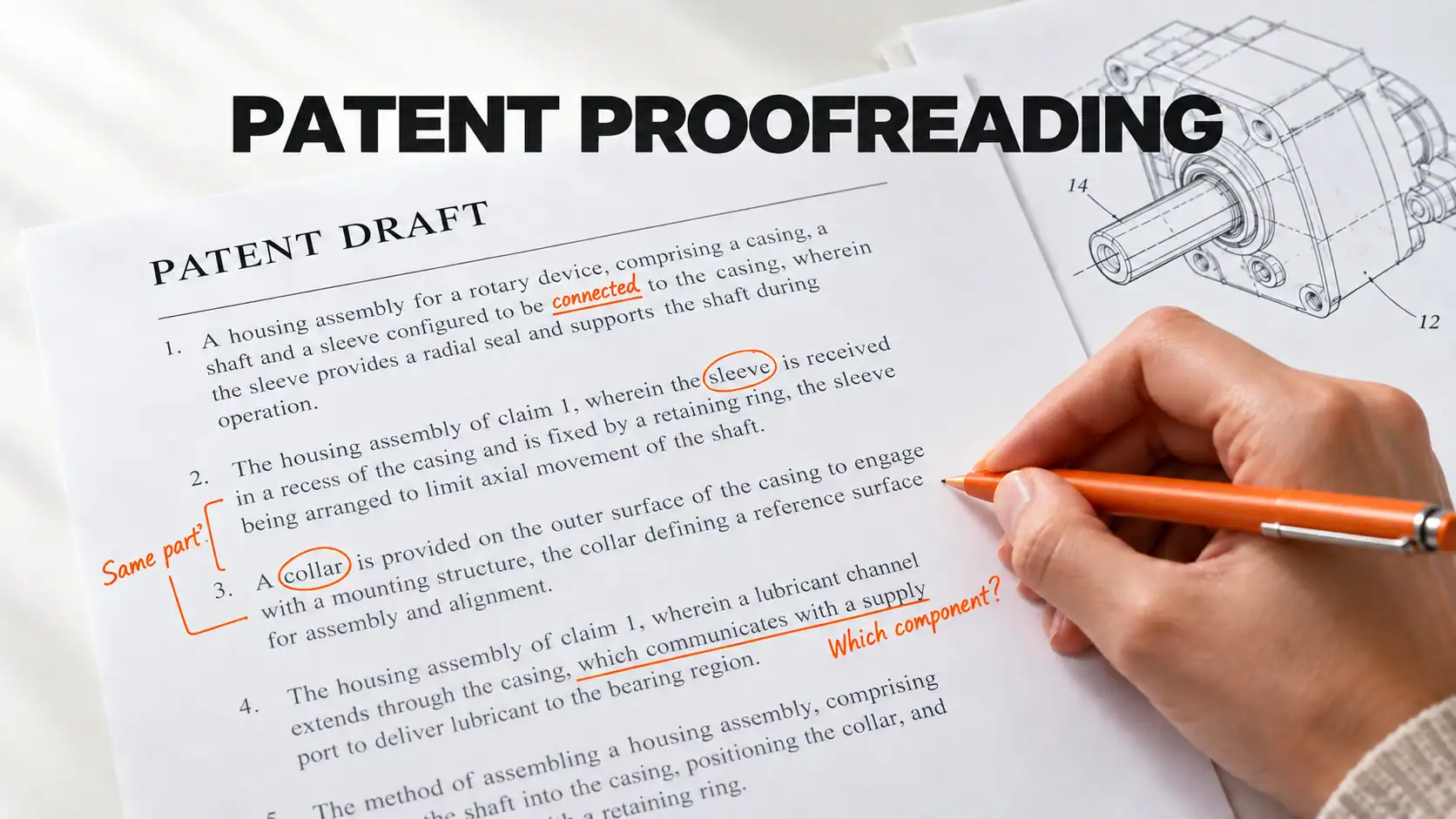
A component changes its name halfway through a patent application. A reference sign points to the wrong feature. A sentence mentions “the” sensor, although no sensor has yet been introduced. None of these things necessarily makes a passage difficult to read at first glance. However, they become harder to overlook when you have to translate them.
In translating patents from German and Russian into English, and in translating and revising written opinions of the International Searching Authority, I regularly encounter these consistency problems. Translation requires decisions about what the words identify and how the parts fit together. A sentence that sounds plausible still has to describe a coherent technical relationship.
This experience suggests five useful checks for patent proofreading. They complement substantive legal review by concentrating on how clearly the document communicates its technical content. PCT Article 6 requires clear, concise claims supported by the description; and the practical work of checking clarity starts with several fundamental questions a reader can ask about the text.
1. Does the wording make technical sense?
Spellcheck is quite content with a correctly spelt word in the wrong place. A technical reader may be less comfortable.
I have encountered a summary in which an ordinary German word made no sense in context. Only by consulting the original description could I establish the intended technical property. The description supplied the evidence needed to resolve the error.
Such errors can become more conspicuous in translation. A reader of the original source text may recognise what looks like a slip and mentally repair it. Translated into another language though, the accidental word can look like a deliberate choice of a completely different term.
A public example shows how small a typographical error can be. In EPO decision T 465/92, concerning aluminium alloys, claim 8 referred to β′-phase where β-phase was intended. That small mark distinguished different material phases. The Board identified the typo by reading claim 1 and the description as a whole.
When proofreading a patent draft, look beyond spelling: is each word the one intended, and does it make sense in the technical context? A correctly spelt but unintended word can easily escape notice. Cross-checking related passages and terms across the description and claims for consistency, together with any corresponding features in the drawings, can help weed out errors.
2. Can the reader recognise the same feature throughout?
Imagine an invented example in which a component begins as a “support sleeve”, becomes a “collar” in the description and appears as a “bushing” in a claim. Are these three names for the same component, or three components?
The author may know immediately. The reader needs the full document to establish the answer.
This matters during translation because different source terms cannot safely be treated as interchangeable —even if everything indicates that the same component is being referred to. Standardising them may erase a distinction the author intended; and yet preserving them will reproduce an inconsistency the author may not have intended. However, your patent translator generally has to interpret the precise wording of a patent text as a deliberate choice. Inadvertent variations in expressions of the same objects will ultimately lead to unintended distinctions being created and effectively cemented in the translation.
PCT Rule 10.2 addresses the underlying requirement directly: “The terminology and the signs shall be consistent throughout the international application.”
The same name should be used to refer to the same component. Where components differ between embodiments, different names may be appropriate, but the difference needs to be explained. The reader should not have to guess whether a change of name identifies a different component or simply reflects inconsistent wording.
A component list can help: defining distinct components, each having a single standardised designation/name and reference sign. It is especially useful after revisions or amendments, when a new name may have reached the claims but not the rest of the description.
3. Do the words, reference signs and drawings agree?
Reference signs give the reader a way to move between a verbal description and the illustrated construction. For a translator deciding what a component actually is, that connection can be decisive.
A drawing may show whether a feature is a projecting rib, a connecting web or a surrounding wall. Its shape and position can help explain a term that, taken alone, would allow for several translations. A wrong or missing sign makes that investigation harder.
PCT Rule 11.13(l)–(m) requires correspondence between signs in the description and drawings, and consistent signs for the same features throughout the application. Paragraph (n) also recommends a separate list where drawings contain many signs.
The practical check is three-way: component name, reference sign and illustrated feature. Finding the reference sign somewhere in the drawing is only the beginning. Does it identify the feature described? Has a revised figure left an outdated reference elsewhere? Does the same reference sign retain its meaning across the document?
This cross-check supports understanding, although it does not remove the need for clear claim wording.
4. Do “a” and “the” identify the intended object?
Articles are easy to skim past. Yet “a sensor” can introduce an object, while “the sensor” asks the reader to identify a particular one.
After introducing “a first sensor” and “a second sensor”, references to those same objects should preserve their identity. Reintroducing “a first sensor” may suggest another object. Conversely, “the sensor” can leave the reader looking for an introduction that never occurred.
When proofreading, pause at expressions such as “the stem” or “said opening” and check how the feature has been established. Is this its first introduction, or does the wording refer back to an identifiable feature?
In T 0955/15, Reasons 3, changing “the stem (28)” to “a stem (28)” overcame an objection concerning the missing antecedent. The change made the wording introduce the feature instead of referring back to one that had not been established.
Conversely, an earlier introduction may not always be essential to understanding. In T 0370/00, Reasons 2, the Board accepted “said opening” because the claim and description identified only one relevant opening, consistently bearing reference sign 5.
Nevertheless, catching these issues while preparing the application can help avoid uncertainty during examination. When proofreading, follow each reference: which feature does this expression identify, and what makes that clear? If several features could fit, specify the intended one. If the feature is being introduced for the first time, check whether ‘a’ or ‘an’ would express that more clearly.
When checking dependent claims, follow the actual dependency. A feature may already be established in the claim being referred to; appearing in an unrelated earlier-numbered claim does not establish that connection. PCT Rule 6.4 explains how dependent claims incorporate the limitations of their parent claims.
Translation adds another reason to pay attention. Russian has no articles; German has them, but their use does not always transfer directly into English. Choosing the English article requires understanding the reference.
5. Can the reader tell which feature does what?
Consider this invented phrase:
“The bracket on the cover, which is connected to the housing…”
Which is connected: the bracket or the cover? The nearest noun suggests one reading, but the intended construction may be another. Once the relationship is confirmed, repeating the component name can make it explicit.
Longer sentences multiply opportunities for uncertainty. A qualification may sit several clauses away from the feature it describes. Passive wording may leave an action’s performer unstated where that information is needed to understand the mechanism.
German relative pronouns can supply gender and number clues that the English “which” lacks, although those clues do not distinguish candidates sharing the same properties. This is one reason German patent translation can require sentence restructuring. If the original itself is ambiguous, however, fluent English cannot settle the author’s intention.
The test is practical: can the reader follow each action, connection and qualification back to the right feature?
A final clarity check
Before treating the wording as finished, ask:
- Technical meaning: Are the words and symbols those intended, and do they make sense in context—even where spelling and grammar appear correct?
- Consistent terminology: Is each feature named consistently throughout the application, with any deliberate differences in terminology clearly explained?
- Reference signs and drawings: Do component names, reference signs and illustrated features correspond consistently?
- Introducing and identifying features: Is it clear when wording introduces a feature and when it refers back to one already established, including through claim dependency?
- Technical relationships: Is it clear which feature performs each action, has each property or is described by each qualification?
Translation may uncover these problems after filing. And that discovery can still be useful, but the underlying questions are worth asking while the application is being prepared. The author can then make the intended relationship explicit, rather than leave a later reader to reconstruct it.
For German- or Russian-to-English patent translation, or revision of an existing translation, see our patent translation and revision services.
