
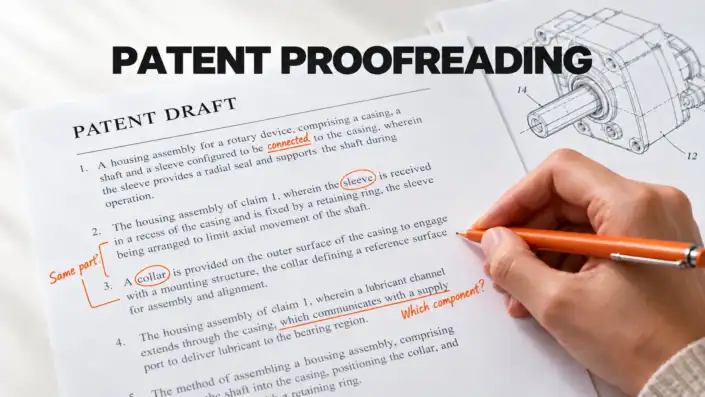
Patent proofreading: five checks for clearer applications
A patent translator shares five proofreading checks for clearer applications, covering terminology, reference signs, articles and sentence structure.

Translating a terminology system, not a list of words
German patent terminology has to remain coherent across an entire specification. This article explains why terms cannot be translated in isolation.

Building the invention in your head: the hidden reasoning behind patent translation
Patent translation is not simply a matter of replacing German words with English ones. An experienced patent translator must reconstruct the invention, test terminology against the description, claims and drawings, and avoid making the English either broader or narrower than the original.
Idiosyncrasies of German patent translation — part 3
German patent terminology requires more than a dictionary equivalent. Examples including “im Wesentlichen”, “Verfahren” and “Steg” show how patent conventions, article usage, technical function and drawings inform the choice of precise English wording.
Idiosyncrasies of German patent translation — part 2
German patent sentence structure can become ambiguous when followed too closely in English. Practical examples explore relative clauses, punctuation and active or passive constructions, showing why translators must preserve technical relationships rather than simply reproduce the original word order.
Idiosyncrasies of German patent translation — part 1
German patent translation challenges extend beyond technical vocabulary. This introduction examines word order, punctuation, passive constructions and context-dependent expressions, explaining why accurate translation requires careful interpretation of the source text alongside drawings, reference signs and related patent documents.

Key reasons for patent translation
From overseas patent applications to licensing and disputes, patent translation serves several legal and commercial purposes. Discover seven reasons why accurate translations matter when communicating an invention, pursuing protection internationally and supporting business decisions across language barriers.
Why are patents translated?
Patent translation requirements depend on where protection is sought and how an application progresses. This overview explores the role of language in international patent applications, including why English translations are widely used and can provide a basis for translation into other languages.
What are patents and why translate them?
What is a patent, and where does translation fit into the picture? An introduction to patents as intellectual property, their role in protecting inventions and encouraging innovation, and the reasons translation can become necessary when seeking protection across borders.
Clarity of invention — care with combinations
Patent claim clarity can suffer when optional features and “and/or” combinations multiply. Drawing on experience with written opinions, this article examines how alternatives and dependent claims can make the claimed subject matter harder to interpret and assess.
Why use human translation for patents?
Human patent translation involves more than producing fluent sentences. Explore the specialist judgement involved in investigating unclear passages, checking terminology and reference signs, consulting drawings and patent families, and identifying source-text inconsistencies that require closer examination or clarification.