
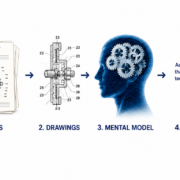
There is a stage in patent translation that happens before the right English words appear on the page.
You build the invention in your head.
Not necessarily every screw, surface and electrical connection. But you need enough of a working model to understand what the components are, how they relate to one another and what they actually do.
Which part fits inside which? What moves? What remains stationary? Does an opening extend through a component or merely into it? Is a particular element physically underneath another, or simply more fundamental to the invention? Do two parts rotate independently, or together?
Until questions like these begin to resolve themselves, apparently straightforward words can be surprisingly difficult to translate.
This is one reason I find the description of patent translation as converting words from one language into another rather inadequate.
The words provide the evidence.
The translator has to reconstruct the invention behind them.
A component can be drehfest – and still rotate
One of my favourite examples from German patents is drehfest.
At first sight, “fixed against rotation” seems an obvious enough concept.
But fixed against rotation relative to what?
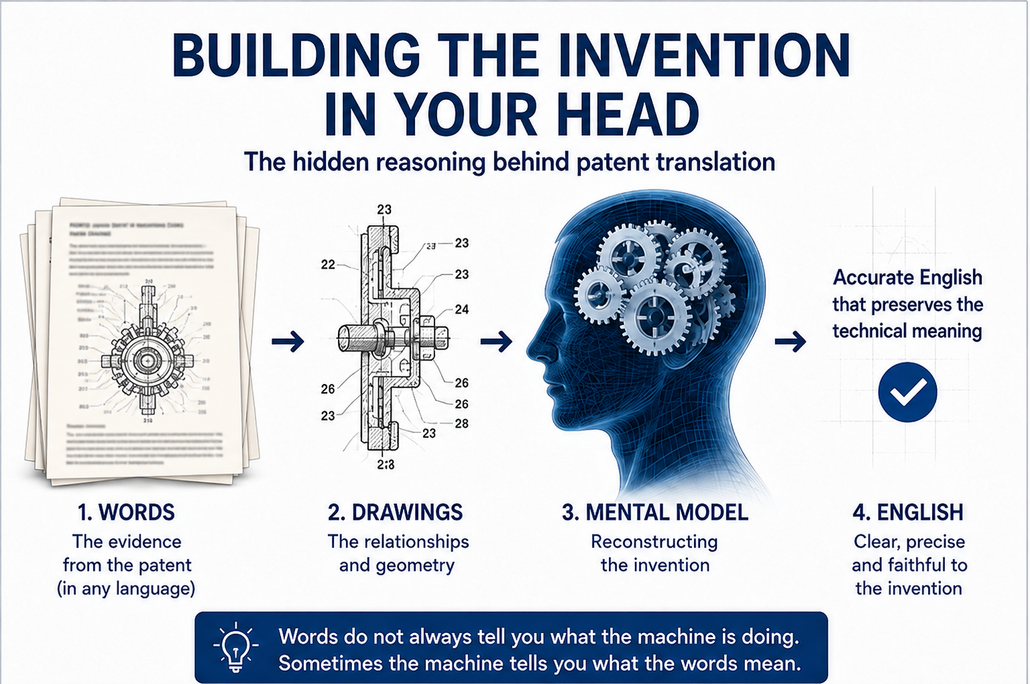
Suppose component A is described as drehfest mit component B. It may mean that A cannot rotate relative to B.
That does not mean that either component is stationary.
A and B might be rotating together at considerable speed.
The important technical relationship may therefore be conjoint rotation: two components are connected in such a way that rotation of one is accompanied by rotation of the other.
If I understand drehfest simply as a property of component A – “A does not rotate” – I have constructed one machine.
If I understand it as a relationship between A and B – “A and B do not rotate relative to one another” – I may have constructed a completely different one.
The German word has not changed.
My understanding of the invention has.
And that leads to a principle that applies surprisingly often in patent translation:
The words do not always tell you what the machine is doing. Sometimes the machine tells you what the words mean.
Choosing a word can mean choosing a geometry
Consider Ausnehmung.
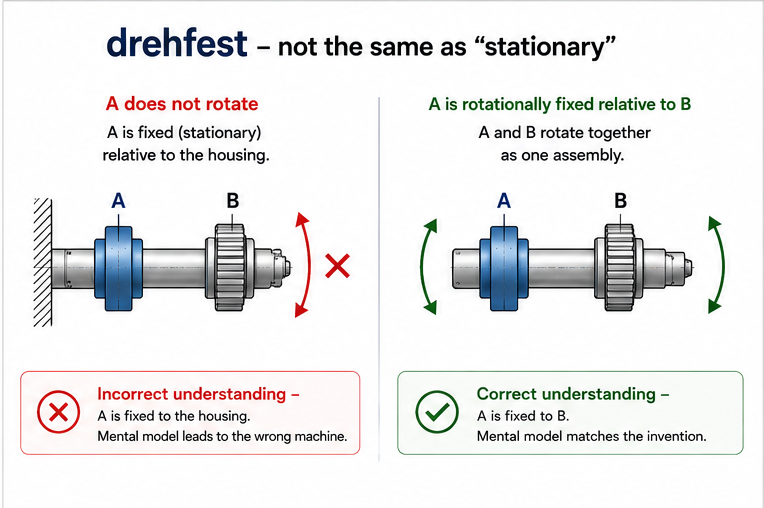
A bilingual dictionary might offer “recess”. In many patents, “recess” will be exactly right.
In others it won’t.
An Ausnehmung might be a recess, opening, aperture, cut-out, notch, cavity, slot or through-hole. Depending on the context, some of those possibilities may be technically distinct.
If I call the feature a “recess”, I may imply that it extends into a component without passing through it.
What if figure 3 shows otherwise?
Perhaps the feature extends all the way through the component. Now “through-hole” may be more appropriate.
But even that decision deserves scrutiny. Does the source actually tell me that the feature is a hole? Is its geometry important? Would “opening” preserve the breadth of the German more faithfully?
The apparently simple act of choosing an English noun can therefore amount to choosing a physical geometry for the invention.
This presents the translator with two opposing risks.
One is understanding too little and choosing the wrong term.
The other is claiming to understand more than the patent actually tells us.
The most specific English term is not automatically the most accurate.
Sometimes accuracy means resisting specificity.
What exactly is a Steg?
Then there is Steg.
Anyone who translates German technical material regularly will probably have developed a complicated relationship with this word.
A Steg might plausibly become a web, rib, bridge, bar, connecting portion or something else entirely.
The dictionary can give me candidates.
It cannot tell me which candidate the inventor built.
So I start looking around the invention.
Where is the Steg?
What is on either side of it?
Does it span an opening?
Does it reinforce another component?
Is it a narrow integral portion joining two larger regions?
Does it separate two spaces?
Can I see it more clearly in a sectional view?
What does the description say it actually does?
This is where patent drawings can stop being illustrations and become evidence.
A reference sign may allow me to follow the same component through several views. A sectional drawing may reveal a geometry that was invisible elsewhere. A sentence several pages away may finally establish its function.
Only then does one of the English candidates begin to look convincing.
Sometimes.
When ‘base’ doesn’t mean a base
German compounds can create a different problem because their internal structure can make a particular English translation look almost inevitable.
Take Grundelement.
Grund plus Element. “Base element.”
Perfectly logical.
Except that “base element” conveys a fairly strong physical idea in English. It suggests something foundational: perhaps a lower part, support or structure on which other components are arranged.
But Grund- can also point towards something basic, principal or fundamental.
Perhaps the Grundelement is actually the principal element of the device, surrounded by subsidiary components, without physically forming a base for anything.
“Main element” might then describe the intended relationship better.
Or perhaps neither does.
The important question is therefore not:
What does Grundelement mean?
It is:
What is this Grundelement in this invention?
Breaking a German compound into English equivalents for its constituent parts can produce a linguistically plausible answer before the technical question has even been asked.
Translating relationships between words
A still more interesting problem arises when a patent uses several apparently similar terms.
Suppose I encounter:
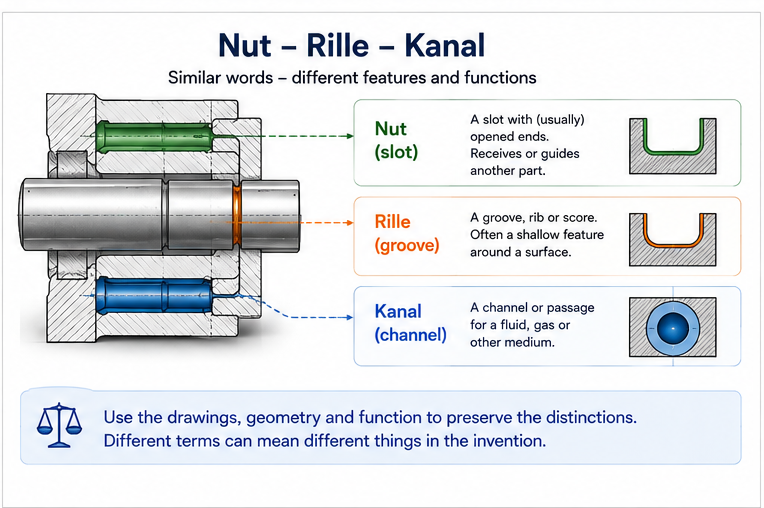
Nut
Rille
Kanal
Depending on the technical context, “groove” might initially look plausible for more than one of them.
But what if the patent uses all three consistently for different features?
Now I am not merely trying to translate three German nouns.
I am trying to determine whether the inventor has established three different technical concepts.
The drawings might eventually reveal that the Nut receives another component and is best understood as a slot; the Rille is a shallow surface groove; while the Kanal conducts a fluid and is therefore a channel or passage.
Perhaps:
Nut -> slot
Rille -> groove
Kanal -> channel
Problem solved.
Except patents are rarely so obliging.
The drawings might not distinguish them clearly. Their functions may overlap. The drafter may even have used the terms inconsistently.
The important point is that terminology has to be considered as a system.
If the source distinguishes A from B, indiscriminately using the same English term for both may erase that distinction.
But the opposite is equally dangerous.
If one German term is used consistently for one component, translating it variously as “support”, “mount”, “carrier” and “bracket” merely because English prose normally favours lexical variety can create distinctions that were never present.
A patent translator therefore translates terminology in two directions.
Vertically:
What English term corresponds to this German concept?
And horizontally:
How does this concept relate to all the other concepts in this document?
This is why deliberately repetitive English can sometimes be excellent patent translation.
When a ‘direction’ isn’t quite a direction
Spatial terminology creates another kind of trap.
German technical texts frequently use constructions such as in Axialrichtung and in Umfangsrichtung.
The obvious translations are “in the axial direction” and “in the circumferential direction”.
Sometimes those are perfectly satisfactory.
But the word Richtung can tempt us into attributing more directional meaning to the English than the physical situation warrants.
Something extending or moving axially may be following an axis without the text distinguishing one direction along that axis from the opposite direction.
Likewise, circumferential movement may occur along a circumference without specifying clockwise rather than anticlockwise movement.
So what is the patent actually describing?
A direction?
An orientation?
An extent?
A path?
An axis along which something can move in either sense?
The danger here is particularly subtle because a literal translation may be impeccable English.
It may sound technical and precise.
The problem is that the English translation may simply be more precise than the invention.
Patent translation is iterative
All these examples expose something else about the working process.
Terminology is not always decided once.
Suppose I encounter Grundelement on page two and provisionally use “base element”.
Then I continue translating.
On page nine, another embodiment reveals its relationship with three other components. Figure 6 shows its geometry from a different angle. Suddenly my “base” isn’t behaving very much like a base.
My mental model changes.
So I go back.
This is normal.
The process is less:
source word -> dictionary -> English word
than:
source text -> provisional interpretation -> mental model -> further evidence -> test interpretation -> revise model -> revise terminology -> test again.
A translation can therefore contain conclusions reached twenty pages after the words that prompted them.
That is one reason patent translation is such an intensely cross-referential activity.
Reading the patent sideways
Patent documents lend themselves to this kind of investigation.
A difficult expression in the description sends me to a drawing.
The drawing gives me a reference sign.
The reference sign takes me to another paragraph.
A claim makes me question the relationship I thought existed.
Another embodiment reveals that a term has to work more broadly than I initially assumed.
Sometimes the patent itself is insufficient and the investigation extends further.
A member of the same patent family may express something more clearly. Prior-art documents may reveal established terminology for the technology. Other patents from the same applicant or inventor may show how a recurring component is normally described.
None of this means replacing the source with whatever another document says.
It means gathering evidence with which to understand the source.
Patent translation can consequently feel less like reading a document from beginning to end and more like navigating a network.
And sometimes the drawings don’t save you
There is a tempting neatness to all this:
Ambiguous term.
Consult figure 4.
Locate reference sign 37.
Mystery solved.
Real patents are less considerate.
A drawing may be schematic. The relevant view may not exist. Two components may be impossible to distinguish. The description may repeat the same ambiguous terminology without adding anything useful.
Sometimes the source contains an apparent error.
Sometimes the reference sign seems wrong.
Sometimes you eventually conclude that the information needed to resolve the ambiguity simply isn’t there.
That is where inference and professional judgement become important.
But so does restraint.
There is a boundary between determining what an inventor probably means from the available evidence and silently adding information that the source never contained.
The translator should not make an invention artificially more coherent, specific or unambiguous simply because better English would result.
Sometimes accuracy means knowing what the patent tells you. Sometimes it means recognising what it doesn’t.
Claims: where relationships matter
These questions become particularly important when translating patent claims.
Claims are not ordinary technical prose. Under Article 6 of the Patent Cooperation Treaty, they define the matter for which protection is sought and must be clear, concise and fully supported by the description.
The translator’s role is not to rewrite those claims or make legal judgements on the applicant’s behalf.
It is to preserve their meaning.
That makes relationships important.
Is A connected to B?
Is A rotationally fixed to B?
Does a feature extend through something or merely into it?
Is a limitation associated with one element or several?
Does a term encompass several geometries or have I inadvertently selected only one?
The question cannot therefore stop at:
Does my English sentence sound right?
It has to include:
Does my English sentence still describe the same technical arrangement?
Fluent English and technical understanding are not the same thing
Artificial intelligence makes this distinction increasingly interesting.
Modern machine translation can produce remarkably fluent patent text. WIPO itself operates patent-specific neural machine-translation technology, and automated translation has transformed access to foreign-language patent information.
But fluent output does not remove the underlying technical question.
Suppose software gives me:
Ausnehmung -> recess
The English is perfect.
The question remains:
Is it a recess?
Or consider drehfest.
The system may generate a grammatically impeccable expression involving rotational fixing.
But has the output preserved the correct relationship between the components?
A translation can be linguistically convincing while quietly constructing the wrong machine.
The interesting boundary for professional patent translation is therefore not simply “human versus machine”.
It is between generating language and establishing meaning.
Making the invisible reconstruction visible
Recently, I have been exploring that idea from a completely different direction.
For Patents Brought to Life, part of my Translating Patents media project, I have been attempting to reconstruct unusual historical inventions visually from their patent documents.
Instead of asking what an invention should look like in English, I am asking what it might actually have looked like.
The process has felt oddly familiar.
A drawing gives me one piece of evidence.
A sentence in the description gives me another.
A reference sign changes my interpretation of a component.
Another figure reveals something hidden in the first.
Occasionally the documents leave something unresolved and I have to decide how much can legitimately be inferred.
Gradually, an object emerges.
Only this time other people can see the mental model too.
It has made me realise that the visual project is, in a sense, an external version of something I have been doing throughout my career as a patent translator.
The final reconstruction is simply different.
In Patents Brought to Life, it becomes an image or moving object.
In my translation work, it becomes English.
Finding the invention inside the words
Perhaps that is the hidden craft of patent translation.
Dictionaries matter. Patent databases matter. Search tools, terminology resources, translation software and machine translation all matter enormously.
But sooner or later, somebody has to decide what the words are describing.
A Steg has to acquire a shape and function.
An Ausnehmung has to become an intelligible physical feature — while remaining no more specific than the evidence allows.
A Grundelement has to find its place in the hierarchy or geometry of the device.
A Nut has to distinguish itself, if necessary, from a Rille and a Kanal.
And two components described as drehfest may have to start spinning together in the translator’s imagination.
Only then can the words really settle into place.
A finished patent translation contains no visible gears, shafts, bearings, circuits, channels or moving parts.
But somewhere between the source document and the finished English, I may have had to assemble them all.
Before you can translate the words, you have to find the invention inside them.